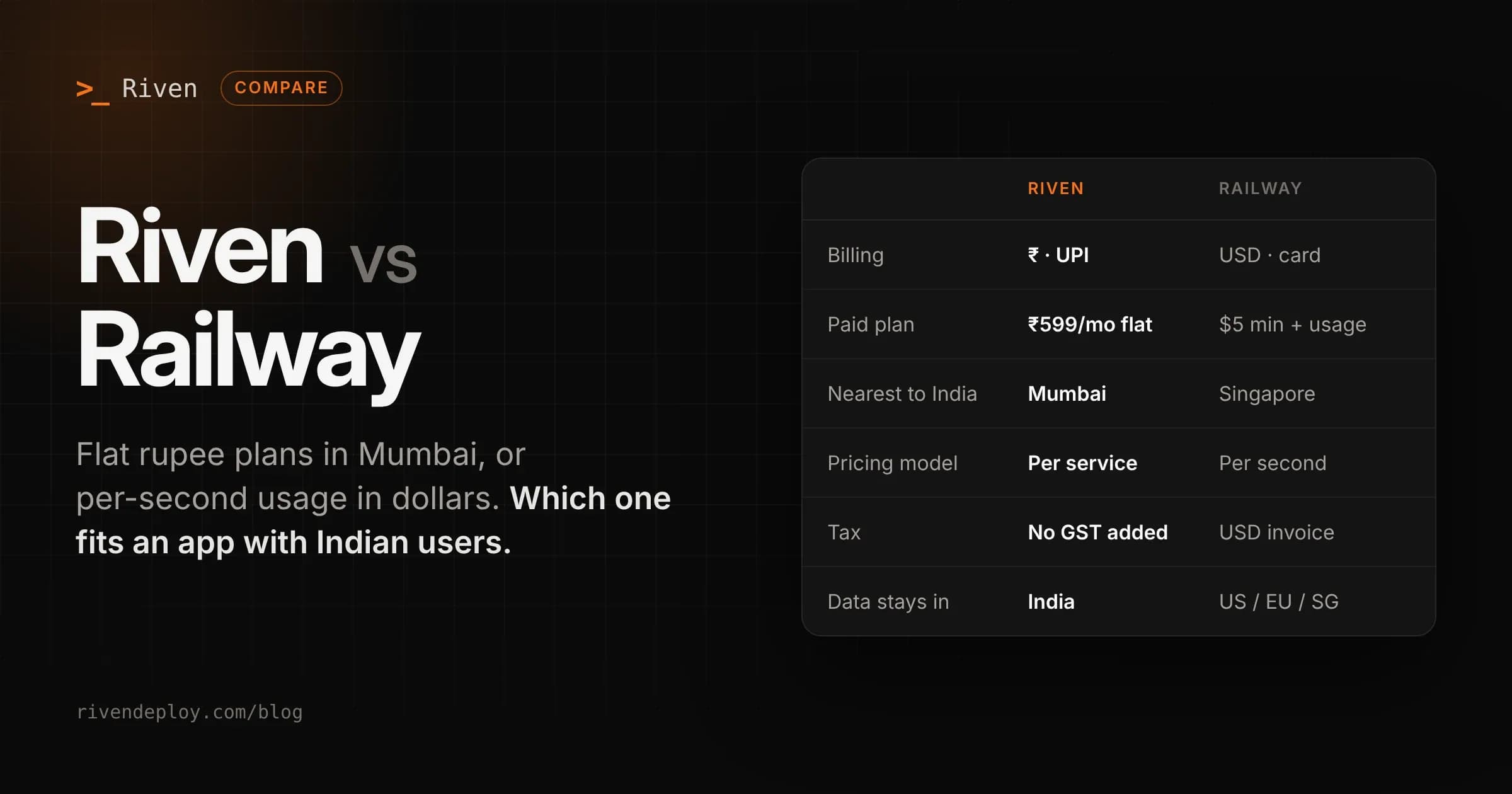
Railway and Riven are closer to each other than most platforms. Both deploy from GitHub, both run your app as a long-running server, and both can run a database next to it. The differences are in how you pay, where your app runs, and how much you want to tune.
I build Riven, so keep that in mind. Everything about Railway here comes from their own pricing page and docs, linked at the end.
The short answer
- You want fine-grained control, big resource limits, or regions in the US and Europe: Railway.
- Your users are in India and you want a fixed monthly bill in rupees: Riven.
- You're running a tiny hobby service and don't mind paying in USD: Railway's Hobby plan is hard to beat on price.
How pricing works
This is the biggest difference between the two.
Railway charges by usage, per second. You pay for the CPU, memory, volume storage and outbound bandwidth your services actually use. The Hobby plan has a $5 monthly minimum that includes $5 of usage. Pro has a $20 minimum with $20 of usage and unlimited team seats. Anything above the included amount is billed on top. New accounts get a 30 day trial with $5 of credit.
Riven charges a flat price per service, in rupees. A web service is free (sleeps when idle), ₹599, ₹1,499 or ₹3,499 a month. Static sites are free or ₹299. Databases are ₹399 or ₹799. Bandwidth above your plan's included amount is a few rupees per GB. You can see every limit on the pricing page.
| Riven | Railway | |
|---|---|---|
| Free | 1 web service (sleeps when idle) + 1 static site | 30 day trial with $5 credit, then a limited free plan |
| Entry paid plan | ₹599/month, 1 always-on service | Hobby, $5 minimum usage per month |
| Team plan | Workspaces on every plan, billed per service | Pro, $20 minimum usage, unlimited seats |
| Billing model | Flat price per service | Per-second CPU, RAM, storage and egress |
| Currency | INR via UPI, cards, netbanking | USD, card |
| Tax | No GST added on top | Billed in USD |
What a small API actually costs
Let's be honest about the low end. A small API using about 0.1 vCPU and 256 MB of RAM around the clock comes to roughly $4.50 a month at Railway's published rates. That fits inside the Hobby plan's $5 minimum. For one small service, Railway is cheaper than Riven's ₹599 plan.
The picture changes as the app grows. On usage billing your bill moves with traffic, memory leaks, a stuck worker or a busy database. A service that settles at 0.5 vCPU and 1 GB of RAM all month is around $20 in compute alone, before storage and egress. That's fine if you watch it. If you'd rather know the number on the first of the month, a flat plan is easier.
There's also the cost of paying in dollars from India: your bank's forex markup on every charge, and international card payments that sometimes fail because of recurring-mandate rules. UPI doesn't have that problem.
Where your app runs
Railway has four regions: US West (California), US East (Virginia), EU West (Amsterdam) and Southeast Asia (Singapore). There's no region in India today. For Indian users, Singapore is the closest, so every request crosses to Singapore and back.
Riven runs everything in Mumbai (AWS ap-south-1). Your app, your database and your data stay in India. That keeps latency low for Indian users and makes it simpler to answer customers who ask where their data is stored. I wrote more about latency in A CDN does not make your app fast in India.
Databases and backups
Both platforms run databases next to your app.
On Railway, databases run as services with persistent volumes. You can deploy Postgres, MySQL, Redis, MongoDB and many more from templates. Volume backups can be taken manually or on a schedule (daily, weekly or monthly), and they're billed like volume storage. Usage-based billing applies here too, so a database that holds a lot of data or stays busy costs more.
On Riven, managed databases are a separate plan: PostgreSQL, MySQL, MongoDB and Valkey (Redis-compatible), all in Mumbai. Backups run automatically every day, the plan decides how long they're kept, and you restore from the dashboard. On the Dhara plan you can open outside access and limit it to IP addresses you choose.
Sleeping services
Both platforms can put an idle service to sleep.
On Railway it's an opt-in setting called Serverless. A service sleeps after roughly 5 to 10 minutes with no outbound traffic and wakes on the next request. The first request after waking can be slow or return a 502, and things like an open database connection can keep it from sleeping at all.
On Riven, only the free Ankur plan sleeps. Paid plans are always on, so there's no cold start to plan around.
Where Railway is better
- Scale and limits. Railway's Pro plan goes up to 1,000 vCPU and 1 TB of RAM per service. Riven's plans are sized for small and medium apps.
- Regions outside India. If your users are in the US or Europe, Railway has a region near them. Riven is Mumbai only.
- Templates. Railway has a large template library. You can launch most open-source tools in a click.
- Builds for unusual apps. If your app needs system packages like ffmpeg or ImageMagick, Railway's builder handles more cases out of the box. On Riven you'd add your own Dockerfile.
- Paying only for what you use. If your workload is tiny or very bursty, per-second billing can come out cheaper.
Where Riven is better
- Your users are in India. Mumbai is closer than Singapore, and your data stays in the country.
- You pay in rupees. UPI, Indian cards and netbanking, with no GST added at checkout and no forex markup.
- You want a fixed bill. The price on the plan is the price you pay, apart from bandwidth over the included amount.
- You want simple defaults. Riven detects your framework and deploys it without you sizing CPU and memory or tuning sleep settings.
- You deploy from your editor or an AI assistant. Riven has a CLI and an MCP server, so you can deploy and check services from tools like Claude.
Moving from Railway to Riven
If your app already runs on Railway, it almost certainly runs on Riven too, since both run it as a normal server.
- Sign in to Riven with GitHub and pick the repo. Riven detects the framework and build command. If you have a Dockerfile, it's used.
- Copy your environment variables from Railway.
- If you use a Railway database, create one on Riven, dump your data from Railway and restore it into the new database. Update
DATABASE_URL. - Make sure your app listens on
process.env.PORT, or the equivalent in your language. - Add your custom domain and switch DNS once the new deploy is healthy. Do the database move in a quiet hour and keep the old one running until you've checked the new one.