Heroku made "git push and it's live" normal. Most PaaS platforms today, Riven included, copy its ideas: buildpacks, config through environment variables, apps that listen on $PORT. If you've used Heroku, Riven will feel familiar.
What's changed is Heroku itself. This post covers what Heroku announced in 2026, how the two compare on price and region, where Heroku is still the better choice, and how to move an app across.
I build Riven, so keep that in mind. The Heroku details come from Heroku's own pricing page, docs and blog, linked at the end.
What changed at Heroku in 2026
On February 6, 2026, Heroku published a post called "An Update on Heroku". The short version:
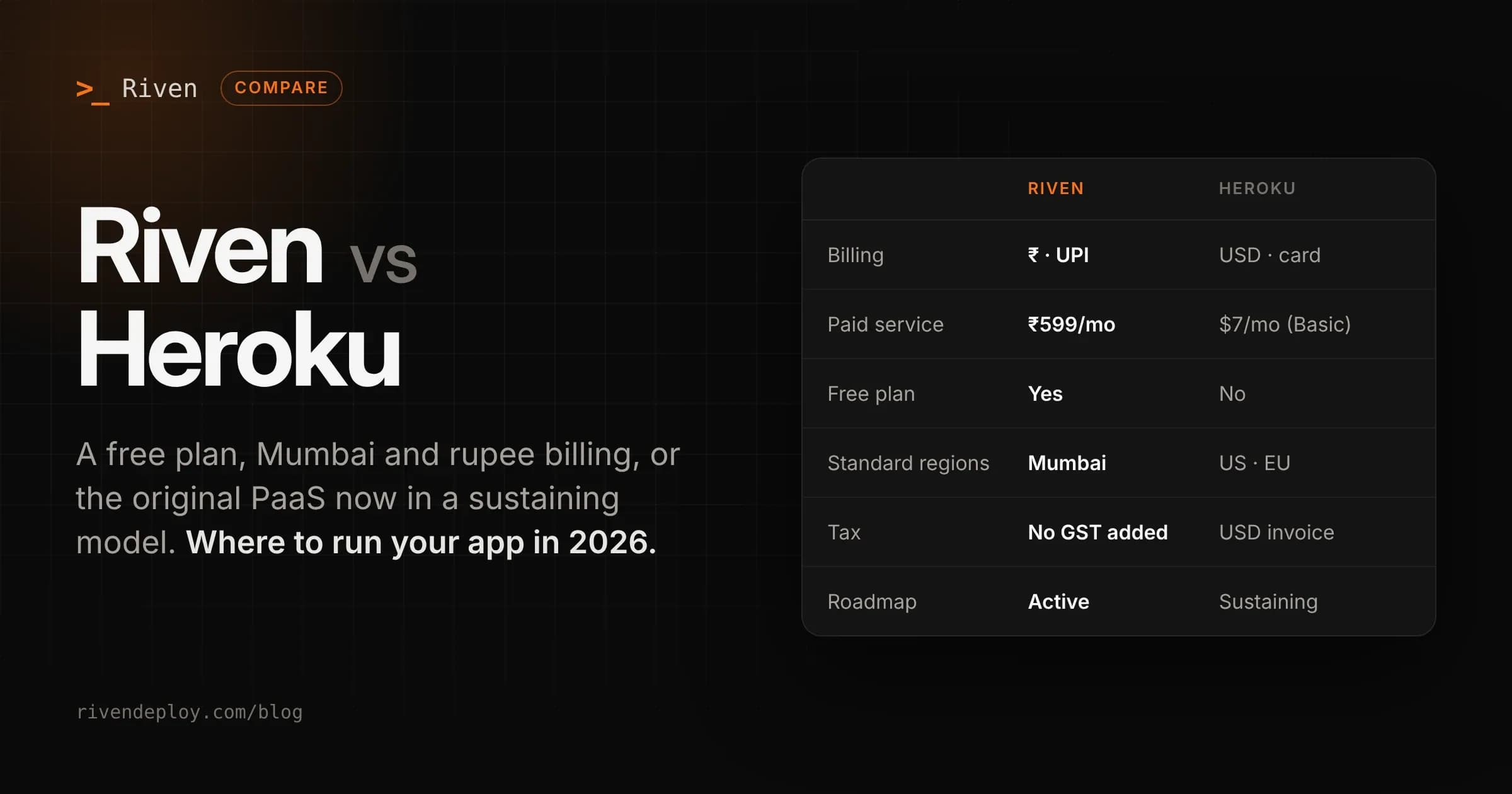
- Heroku is moving to a sustaining engineering model. It will focus on stability, security, reliability and support instead of new features.
- Enterprise contracts are no longer sold to new customers. Existing enterprise contracts continue and can renew.
- Nothing changes for people paying by card in the Heroku dashboard. Pricing, billing and service stay the same, and Heroku says it remains production-ready. So Heroku isn't shutting down, and your app won't stop working. But if you're starting something new, you're picking a platform that has said it won't add much from here. That's the main reason people are searching for alternatives right now.
The short answer
- Your app already runs well on Heroku, you're in the US or Europe, and you don't need new features: stay. It still works.
- You're starting a new project, your users are in India, or you want to pay in rupees: Riven.
- You rely on Heroku's add-on marketplace, pipelines and review apps, or run Ruby, Java or Go apps without a Dockerfile: Heroku still does that better.
Pricing
Heroku prices by dyno, in USD. There's no free plan any more.
| Riven | Heroku | |
|---|---|---|
| Free plan | Yes, 1 web service (sleeps when idle) + 1 static site | No |
| Cheapest option | Free | Eco, $5/month, sleeps after 30 min idle |
| Always-on service | ₹599/month, 256 MB RAM | Basic, $7/month, 512 MB RAM |
| Next step up | ₹1,499/month, 2 services | Standard-1X, $25/month per dyno |
| Smallest Postgres | ₹399/month | Essential-0, $5/month, 1 GB |
| Currency | INR via UPI, cards, netbanking | USD, card |
| Tax | No GST added on top | Billed in USD |
To be fair to Heroku: the $7 Basic dyno has more RAM than Riven's ₹599 plan, and Essential-0 Postgres is cheap. If you only compare resources per dollar for one small app, Heroku holds up.
Where it adds up is the rest of the stack. A Heroku app is usually a web dyno, a worker dyno, Postgres and Redis, each priced separately, and Basic dynos don't scale past one instance. You move to Standard dynos at $25 each for that. On Riven, background workers are included on every service plan, and a database plan covers PostgreSQL, MySQL, MongoDB or Valkey (Redis-compatible). Every limit is on the pricing page.
And as with any USD platform, paying from India means forex markup on every charge and the occasional failed renewal on an international card.
Where your app runs
Heroku's standard runtime (the one you get with Eco, Basic and Standard dynos) has two regions: the US and Europe. Apps go to the US by default.
Heroku does list a Mumbai region, but only for Private Spaces, its isolated network product. It isn't available for regular dynos.
Riven runs everything in Mumbai (AWS ap-south-1), on every plan including the free one. Your app and database share a region and your data stays in India. For an Indian user, the difference between a server in Mumbai and one in Virginia is a round trip across the world on every request. More on that in A CDN does not make your app fast in India.
Databases
Heroku Postgres is mature and well documented. Essential plans start at $5 a month with 1 GB of storage. Redis is a separate product, Heroku Key-Value Store, starting at $3 a month for 25 MB.
On Riven, databases are a separate plan starting at ₹399 a month. Every plan supports PostgreSQL, MySQL, MongoDB and Valkey. Backups run automatically every day and you restore from the dashboard. On the Dhara plan you can open outside access limited to IP addresses you choose. Everything runs in Mumbai.
Where Heroku is better
- Add-on marketplace. Logging, monitoring, search, email, queues: Heroku has an add-on for almost everything, billed on one invoice.
- Pipelines and review apps. Promote builds from staging to production and get an app per pull request. Riven deploys one branch per service and doesn't create per-PR apps.
- Language support. Heroku's buildpacks cover Ruby, Java, Go, PHP, Scala and more out of the box. Riven auto-detects JavaScript and Python frameworks; other languages deploy with a Dockerfile.
- Scale. Performance dynos go up to 126 GB of RAM. Riven is built for small and medium apps.
- Years of production history. Heroku is battle-tested, and it says it's staying focused on reliability.
Where Riven is better
- A free plan. Try it, deploy a side project, demo something, without a card.
- Mumbai on every plan. Not just on an isolated enterprise product.
- Rupee billing over UPI, with no GST added at checkout.
- Workers included on every service plan instead of separate dynos.
- Active development. New features ship regularly, and you can see them on the changelog.
- Deploy from your editor or AI assistant. Riven has a CLI and an MCP server, so you can deploy and check services from tools like Claude.
Moving a Heroku app to Riven
Heroku apps already follow the habits Riven expects, so most move without code changes.
- Check the start command. Your
Procfiletells you how the web process starts. Make sure the app listens on thePORTenvironment variable, which it almost certainly already does on Heroku. - Connect the repo. Sign in to Riven with GitHub and pick the repo. Riven detects Node and Python frameworks. For Ruby, Java, Go or anything unusual, add a Dockerfile.
- Copy config vars. Run
heroku config -a your-appand add the same values as environment variables on Riven. - Move Postgres. Create a database on Riven. On Heroku, run
heroku pg:backups:captureand thenheroku pg:backups:urlto get a download link for the dump. Restore it into Riven withpg_restore, then updateDATABASE_URL. - Switch the domain. Add your custom domain on Riven, check the new deploy, then update DNS. Keep the Heroku app running for a day or two in case you need to roll back.